Tuesday, 23 December 2014

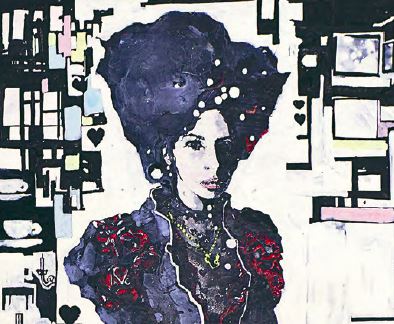
A Red & Pleasant Land: The Alice – A New Character Class

I am crap at writing reviews, so instead of writing a review of the marvellous Lamentations of the Flame Princess sandbox supplement titled A Red & Pleasant Land, I will be posting a blog entry for each of its chapters. That will be my way of writing a review of sorts, by showcasing how inspiring reading the book has been to me.

Chapter II of A Red & Pleasant Land is entirely devoted to the description of a new LotFP character class called The Alice. Now instead of merely paraphrasing this chapter (because that's pretty much all you can do with a technical piece such as a new character class), I'll be repurposing The Alice character class for the Monsters & Magic role-playing game, along the lines of what David Rollins has done for D&D 5e.


The Alice
a new character class for Monsters & Magic

Prime Attribute: Dexterity
Physical Hit Points: D4
Mental Hit Points: D10
Starting Money: 3D4×10

As explained in A Red & Pleasant Land, whereas your average adventurer sets out looking for adventure, in the case of Alices, it is actually adventure that seeks them. The Alice is a mysterious magnet for odd occurrences, perplexing phenomena, and extraordinary endeavours.

Restrictions
Alices are human, and from a civilised background.


Alice Traits
✠ Light Armour
✠ Simple 1-Handed Weapons
✠ Tool of the Trade: Choose one particular Game or Musical Instrument
✠ Luck Manipulation (as described in Aperita Arcana)
✠ Read and Write
✠ Exasperation, per the text in A Red & Pleasant Land, but use the Effect Engine instead of rolling the dice, i.e.:
  • Difficulty: whatever is causing the exasperation, or a GM-set value (p37 of M&M)
  • Minor effect, subtract 5 and read the resulting number on the Exasperation table on p31 of A Red & Pleasant Land
  • Major effect, subtract 10 and read the resulting number on the Exasperation table, allow for some leeway
  • Extreme effect, let the Alice choose the number on the Exasperation table

Alice Advancements
Each time the Alice levels up, instead of letting the player choose the advancement, have them roll 1D100:

 1D100 Roll   Results 
 01-20   The Alice may choose one of the Monk traits on p17 of M&M as an Advancement 
 21-70   The Alice may choose one of the Thief traits on p22 of M&M as an Advancement 
 71-74   per the text of the Alice D100 Level Up Table on p32-33 of A Red & Pleasant Land 
 75   The Alice gets Recognise Faction or Function of Any Voivodjan Aristocrat as an Advancement 
 76-79   per the text of the Alice D100 Level Up Table 
 80   The Alice may replace STR with CHA in a combat roll 
 81   The Alice gets Identify Drugs & Plants as an Advancement 
 82   The Alice gets Lie Convincingly as an Advancement 
 83   per the text of the Alice D100 Level Up Table 
 84   The Alice gets Voivodjan Etiquette as an Advancement 
 85-87   per the text of the Alice D100 Level Up Table 
 88   The Alice gets an extra language as an Advancement 
 89   The Alice gets Artistic Forgery as an Advancement 
 90   The Alice gets Appraise Treasure as an Advancement 
 91-93   The Alice may replace STR with DEX in a combat roll 
 94   per the text of the Alice D100 Level Up Table 
 95   The Alice gets Dodge Missiles as an Advancement 
 96   The Alice gets the Stalwart Defence stance (p42 of M&M) as an Advancement 
 97-98   The Alice gets Sylvan Sympathy as an Advancement 
 99-00   The Alice gets Utterly Blasé as an Advancement 


As a bonus, I am adding a further sub-class of the Alice, the Goose-boy, devised by yours truly, and inspired by Lúdas Matyi, the Hungarian epic poem written by Mihály Fazekas.

The Goose-Boy
a new Alice sub-class for Monsters & Magic

Secondary Attribute:Wisdom
Starting Money: 5D6

The Goose-boy is the commoner counterpart to the Alice. The Goose-boy starts as a young peasant boy who leads a quiet life but who is severely wronged by some upper-class NPC, and who sets out on an adventure to settle a score with the NPC.

Restrictions
The Goose-boy is a human from the sticks. The player must choose the reason the PC has become a Goose-boy; possible reasons are:
  • stolen property
  • someone forcibly married his sweetheart
  • killed relative

Goose-boy Traits
✠ Light Armour and Shield
✠ 1-Handed Weapons
✠ Country Bumpkin: Choose one particularly lowly profession such as goose boy, pig herder, etc.
✠ Luck Manipulation
✠ Disguise (p23 of M&M)
✠ Exasperation

Goose-boy Advancements
As the Alice above, except:
75 Sense Orb Loc - the Goose-boy may detect the hidden human settlements of Voivodja
84 Exhort the Commoners - the Goose-boy may stir up trouble against the aristocracy
88 Thieves' Cant - the Goose-boy has learnt the secret language of lowlifes
89 Impersonate Trade - the Goose-boy may pass off as a trader or an artisan
90 Rigmarole - the Goose-boy may fast-talk his way pretty much anywhere

If you are using my 13C setting, Goose-boys are agents of the Trickster.

Thursday, 18 December 2014

13th Age in Csachticz − Detailed Icons, No.3: The Dracul

The Dracul is the name given to the Diabolist in 13C. The surname 'Dracul' stems from the Order of the Dragon, founded in 1408 by the then-Emperor Sigismund (1368–1437) and his wife of ill-repute, Queen Barbara (1392–1451). The scope of the Order of the Dragon is to defend True Faith against the Empire of the Crescent Moon. However, contrary to other similarly-purposed orders, whose foundation lies in religious vows and selflessness, the Order of the Dragon is firmly based upon personal oaths of loyalty and ruthlessness.

The first Dracul, or head of the Order of the Dragon, was Hermann II of Cilli, the father of Queen Barbara. After his death in 1435, the headship was passed on to Vlad II of Herdsland, henceforth known as Vlad Dracul. There were rumours of Queen Barbara and Vlad Dracul dabbling in forbidden magicks and being lovers. Whatever the truth, she certainly put her immense wealth and her political clout behind Vlad Dracul, who rose from being a secondary baron of the Empire of the One Faith to becoming its foremost champion in the south-east. After the Queen's demise, apparently caused by a necromantic ceremony gone awry — she was reportedly trying to become a lich —, Vlad Dracul resumed her dark experiments. He has seldom since been seen in broad daylight, and has always fought his battles against the Empire of the Crescent Moon during the night. These night attacks have terrified the Sultan's troops, especially since the Dracul is known to impale any prisoners taken during these battles.

USUAL LOCATION

The Dracul is seldom to be seen, except when leading his unsavoury host into battle. Rumour has it that he spends the rest of his time in his foreboding fortified tower at Argisch, deep in the most inaccessible part of the Oriental Range.

COMMON KNOWLEDGE

It is common knowledge that the present Dracul, Vlad Dracul, has been around for... something like 200 years, which is obviously very wrong. Since he's made few public appearances in the last 150 years or so, little is known about the means by which he's managed to extend his lifespan to such an incredible amount of years. Some say he has a huge laboratory where he brews life-extending potions; some others that he's transformed into a lich, using the forbidden necromantic lore accumulated by his erstwhile mentor (and lover) Queen Barbara; some others that he's become a vampire, and that his many war prisoners are his lifeblood.

His fortress~tower at Argisch, in an ever dark and stormy part of the Oriental Range, with barely any access road, certainly doesn't invite enquiries.

The few survivors from the notorious night attacks of the Dracul speak of a huge unholy horde of undead riding skeletal horses into battle, but these reports are dismissed as the ravings of disturbed madmen.

ADVENTURERS & THE ICON

The Dracul is a fanatical opponent of the Empire of the Crescent Moon. For him, the end always justifies the means, so he's always looking for spies, assassins, and like lowlifes to further his diabolical deeds. However, anybody associating with the Dracul may find themselves shunned by normal adventurers should news of such an association leak out.

ALLIES

The Dracul is a villainous icon without any ally. Not that he thinks he needs any.

ENEMIES

The Sultan is the Dracul's obsessive enemy, and obviously the Sultan also considers the Dracul as one of his foremost enemies north of the Empire of the Crescent Moon. The Superintendent and the Warlord, who do not agree with the way the Dracul fights against the Empire of the Crescent Moon, are known to have hired holy men and monastic knights to try and root out this evil from the Oriental Range. None of these agents are known to have ever returned.

HISTORY

The Dracul as such is quite a recent Icon compared with the others. However, he draws upon an ancient tradition of necromancy, forbidden lore, and cruelty that has been present in this part of Europe for centuries.

THE TRUE DANGER

The Dracul is obsessed with defeating the Empire of the Crescent Moon, which keeps him busy. Should he turn his eyes towards his erstwhile co-religionists he might corrupt the Fair Kingdom and, beyond it, the Empire of the One Faith!

A Red & Pleasant Land: The Land of Unreason – Geography

Still reading A Red & Pleasant Land, at last now in dead tree format. The setting vividly brought to life in the book, the Land of Unreason, is described by Zak S. as being a mix of Transylvania and Wonderland (page 14):

the world in this book is a sort of alternate-universe Transylvania underneath your “real” Transylvania, reachable through mirrors

A close inspection of the map, however, reveals a land far larger than Transylvania, with Cachtice in the north-western corner, Zombor in the south-west, and Castle Poenari in the south-eastern corner. The north-eastern part of the map is more difficult to identify with any real-world place names, but the shape of the rivers and of the mountains suggests Ruthenia.

As a result, given these geographical limits, the Land of Unreason corresponds quite exactly to the historical Kingdom of Hungary, i.e., the model behind my very own “Fair Kingdom”.

The Land of Unreason used to be a unitary kingdom, the Once Palace. After the demise of the latter, it became a war-torn land, with the two main powers being the Heart Queen, based in the north-west, and the Red King in the south-east. This again somehow reflects the disunity of the Fair Kingdom, torn between the Empire of the One Faith, the Empire of the Crescent Moon, and the independent-minded nobles of Transylvania, who try to keep their distances from both empires.

Should you want to run a mash-up of my Fair Kingdom setting, with its icons, and the Land of Unreason, you could expand on the notion of Twins presented on page 16 of A Red & Pleasant Land. The Fair Kingdom is the geographical twin of the Land of Unreason (and vice-versa). Everybody has a twin in the other land (and vice-versa). The Heart Queen is the Twin of the Blood Countess. The Red King is Vlad Dracul's Twin.

Monday, 15 December 2014

LotFP Adventure Seed

I have several gaming blogs so as to keep my blog entries separated and dedicated to a given genre whenever I feel like posting. This present blog is dedicated to my early modern weird fantasy posts, but I'll briefly mention the Giannirator, my bookshelf-based random adventure generator, from my gaming blog dedicated to Sword & Sorcery.

I have noticed that, whenever I use the Giannirator, most results are geared towards Glorantha, which is actually not a surprise considering that the bulk of my gaming library is composed of RuneQuest/HeroQuest/Glorantha publications. So, in order to showcase a more diverse use of the Giannirator, I'll use my gaming PDFs, which are much more diverse in scope than my dead tree bookshelves.

NPC1 (from PDF One)
1D20 --> 18. Folder No.18.
1D6 --> 3. Start counting from the beginning.
1D30 --> 11. Eleventh PDF from the beginning: D6 Fantasy Locations.
1D6 --> 1. Start counting from the beginning.
1D100 --> 43. Worthington the Priest.

Location1 (from PDF Two)
1D20 --> 7. Folder No.7.
1D6 --> 3. Start counting from the beginning.
1D30 --> 15. 15th PDF from the beginning: A Mighty Fortress.
1D6 --> 3. Start counting from the beginning.
1D100 --> 75. the Scheldt Estuary.

Action (from Table One)
1D20 --> 19. Conquer / Invade / Raid / Pillage / Plunder.

Person/Object (from PDF Three)
1D20 --> 13. Folder No.13.
1D6 --> 4. Start counting from the end.
1D30 --> 23. 23rd PDF from the end: Night Witches.
1D6 --> 1. Start counting from the beginning.
1D100 --> 57. Forbidden Love.

Motivation (from Table Two)
1D20 --> 11. Selflessness.

NPC2 (from PDF Four)
1D20 --> 10. Folder No.10.
1D6 --> 5. Start counting from the end.
1D30 --> 8. Eighth PDF from the end: 13th Age Errata.
1D6 --> 2. Start counting from the beginning.
1D4 --> 4. Putrid Zombie.

Location2 (from PDF Five)
1D20 --> 14. Folder No.14.
1D6 --> 4. Start counting from the end.
1D30 --> 10. Tenth PDF from the end: The God That Crawls.
1D6 --> 2. Start counting from the beginning.
1D100 --> 26. a large "null space" of pure darkness.

Element (from PDF Six)
1D20 --> 5. Folder No.5.
1D6 --> 2. Start counting from the beginning.
1D30 --> 14. 14th PDF from the beginning: D&D 5e Player's Basic Rules.
1D6 --> 6. Start counting from the end.
1D100 --> 36. the Schools of Magic.

Result: Worthington the Priest asks the PCs to go to the Scheldt Estuary to Conquer / Invade / Raid / Pillage / Plunder a Forbidden Love. Motivated by their Selflessness, the PCs will end up confronting a Putrid Zombie in a large "null space" of pure darkness. During the course of the adventure, the Schools of Magic will feature prominently.

This really looks like a nice Lamentations of the Flame Princess scenario seed. So: Worthington the Priest, before settling down as a clergyman, used to be a chaplain in England's Royal Navy during the Anglo-Spanish War (1585–1604). He even saw action at the Naval battle of Gravelines, in 1588, which saw the defeat of the Spanish Armada by the English. Worthington, however, was stranded in Flanders and started a romance with a local Protestant woman, before being repatriated to England. Five years on, Worthington still thinks of his beautiful Flemish lover, and has asked the PCs to go and find her and, if possible, to bring her back to England. The PCs, being incredibly selfless, won't even ask for a reward.
Somehow, the PCs should learn that the woman is now the wife of a prosperous burgher and lives in the fortified Dutch city of Bergen op Zoom. The city is besieged by the Catholics, and the PCs will somehow have to benefit from magical help to get through the besiegers, and into the city. Unbeknownst to them, the husband of the woman is a necromancer and he has a portal in his cellar to the Negative Energy Plane.
The PCs will talk to the woman, she will agree to following them, but the necromancer will discover her plans and lock her in the cellar. The PCs will have to confront the necromancer and his putrid zombie, who keeps regenerating because of its closeness to the Negative Energy Plane.

Wednesday, 3 December 2014

A Red & Pleasant Land (Very First Impressions)

the Blood Countess, Zak-style
James Raggi has made available his latest batch of LotFP books for purchase on his web-site at last, and I have thus ordered A Red & Pleasant Land, the new version of Death Frost Doom, and No Salvation for Witches. I am particularly curious about the former since it is set in a fantasy version of Central Europe. Or should I write, in a Zak S.-ised version of Central Europe.

Lo and behold! One of the major NPCs is the Blood Countess herself. I won't add anything so as not to spoil the surprise for those who are going to play in A Red & Pleasant Land, but other tidbits similar to what has been appearing in my blog also appear in Zak's book, like her castle at Csachticz (spelled Cachtice in the book).

The art (obviously) is superb... More when I have time to read through the book.

Monday, 24 November 2014

The Knights of Rhodes

The Knights Hospitaller (Latin: Fraternitas Hospitalaria) were one of the most prestigious True Faith military orders during the Crusades, when they distinguished themselves in battle against the Crescent Moon. However, at the end of the 16th century, the order is but the shadow of its former self. The disputes between New Wayers and Old Wayers have rendered the presence of religiously-minded knights in battle utterly obsolete, since most battles of the day are now between Europeans.

After the fall of the Crusader states, the order had to relocate to Rhodes, and then finally to Malta in 1530. The order is now mostly known as the Knights of Rhodes after their earlier home.

Dispossessed of their lands in the Levant, rendered idle by the internecine conflicts in Europe, the Knights of Rhodes now resort to piracy against Crescent Moon ships in the Mediterranean, or have become sellswords at the service of the various European powers, and in particular of the Iberian powers, who are the only ones still actively fighting against the Way of the Crescent Moon in distant lands.

The original statutes of the order contemplated the service of the sick pilgrims to the Holy Land, and the defence of the Crusader states. Their habit is a red surcoat with a white Maltese cross emblazoned on it.

The order of the Knights Hospitaller as a role-playing clerical cult: 
Temple traits: Protect True Faith pilgrims, Wage war against the Crescent Moon
Worshippers' Alignment: any non-Evil/Worshippers' Allegiance: Old Way of True Faith
Temple Weapon: Sword
Spheres of Activity: Cure, Protect, Shelter the Faithful.
Powers:
  • all Knights of Rhodes have the Tenacious trait (from the Aperita Arcana supplement)
  • Lawful Good Knights of Rhodes may choose advancements from the Paladin Traits pool on p18 of the M&M core book, replacing 'Evil' with 'Crescent Moon'
Holy Symbol: Maltese Cross.
Spells: Combat, Guardian, Healing, Protection.


Wednesday, 5 November 2014

13th Age in Csachticz − Detailed Icons, No.2: The Alchemist


The Alchemist is the name given to the Archmage in 13C. The title 'Alchemist' definitely sounds more "early modern" than 'Archmage', which smacks of high fantasy. The Alchemist is the embodiment of the intelligence, of the spirit of research, and of the enlightenment of the age: in the 16th century, mathematics, physics and alchemy are not deemed incompatible — it is actually quite the contrary.

There have been many Alchemists in the history of the Empire of the One Faith, but none of them have been as influential as the current one, whose amity with the Emperor and with most learned men of Europe has put him at the exact centre of European alchemical and hermetic studies. If a major endeavour in any of these fields is under way anywhere in Europe, the Alchemist definitely knows about it — he might even be actively involved.

USUAL LOCATION

At his tower on top of Alchemist's Hill near the city of Brüx, approximately 50 miles northwest of Burgstadt along the River Biela.

COMMON KNOWLEDGE

Despite his being a well-known public figure, and despite his many appearances at court, little is actually known about the Alchemist. It is rumoured that he was born about 40 years ago in Albion. He is supposed to have worked as an apothecary at the court of Queen Gloriana, where he quickly rose through the ranks but fell out of favour just as quickly, finding then refuge on the Continent; first at Wittingau, then at Brüx, always enjoying the patronage of the Emperor.

The Alchemist has a huge laboratory in his tower that is rumoured to extend well beneath it into Alchemist's Hill, and even under the city of Brüx. This laboratory~dungeon is equipped with all manner of paraphernalia retrieved by the Alchemist's agents from all the corners of the Empire of the One Faith, and beyond. It is said that each section of the labyrinthine laboratory is devoted to a given art, e.g., one to optics, one to divination, one to summoning, etc.

ADVENTURERS & THE ICON

As per the standard 13th Age core book under Archmage (p14)— the Alchemist hires adventurers to retrieve strange implements, to test new spells, and to volunteer for participating in his séances. Pay is high, but so are the hazards.

ALLIES

The Alchemist has sworn total fealty to the Emperor. Despite the Alchemist's incredible supernatural powers, the oaths he has taken are apparently even stronger.
The Alchemists professes respect for the tenets of True Faith, and in particular for those of the Old Way, but he and the Pope have never been know to actively co-operate. On the other hand, rumour has it that the Alchemist and the Superintendent have worked together to prevent the Sultan from locating certain magic items buried deep in the mountains of the Oriental Range.

ENEMIES

There is an ongoing rivalry between the Alchemist and the Occultist, but it has never escalated into open warfare between their agents.
The Alchemist wants to bend nature under humanity's will; as a result, he has deeply hurt the Erlking and Frau Perchta, who are now openly opposing him.

HISTORY

There has always been an Alchemist working for the Emperor, despite the uneasiness his presence has always brought at court, and the whiff of heresy surrounding his works. Some were grand, some were petty; the current Alchemist is probably the grandest of them all.

THE TRUE DANGER

Danger lies with the Alchemist's various experiments, and in particular his summonings of strange extra-planar creatures. He calls them 'Angels' — but are they?