Showing posts with label R&PL. Show all posts
Showing posts with label R&PL. Show all posts
Saturday, 9 January 2016
Better Than Any Man Prequel
I am going to run a kind of alternative prequel to Better Than Any Man, set before the death of Gabriele Bauer. The latter entrusts the player characters (all of them are female teenagers) with travelling to the War Room in Cachtice, in Voivodja, in order to figure out the exact position of Gustavus Adolphus' army [I know this is not what is written in the description of the war room, but I'm modifying that— in my version of Voivodja, the war room shows the movements of all armies in all known worlds]. Gabriele Bauer intends to use the information to organise the safe escape of Karlstadt's population before the Swedes are upon the hapless town.

Thursday, 1 January 2015
13th Age in Csachticz − Detailed Icons, No.4: The Great Boyar

In 13C, a figure has emerged from this squabble to unite all the petty kingdoms east of the Oriental Range under his iron rule. Little is known about the Great Boyar, except that he commands ruthless hordes to do his bidding.
USUAL LOCATION
The Great Boyar is shrouded in mystery, and so are his whereabouts, although he is rumoured to dwell, attended by beautiful rusalki, at the centre of a vast and foreboding marsh guarded by fearsome vodyanyie.
COMMON KNOWLEDGE
The Great Boyar being a figure shrouded in mystery, and his lands being far and isolated, little is really known about him. Some say he's far taller than a normal person, some say he's not really human, some others that he is of an amphibious nature; some others yet insist all of this is true— and then worse. Yet some argue that all these rumours are purposely spread by the Great Boyar himself to instil a sense of fear in his enemies.
ADVENTURERS & THE ICON
At the moment, the influence of the Great Boyar doesn't really extend over the Fair Kingdom, so adventurers shouldn't feel his influence (yet). However, it is rumoured that the Great Boyar commands many aquatic creatures, such as the already-mentioned rusalki and vodyanyie, and he may have started to gain hold upon the waterways and the marshes of the north-eastern borderlands of the Fair Kingdom.
Also, adventurers who like to plunder more than law may look favourably upon the Great Boyar and the promises of looting that the onslaught of the Eastern hordes might bring upon the Fair Kingdom.
A particularly interesting PC background could be that of the exiled knyaz, a wandering knight pertaining to one of the noble houses on the losing side of the Muscovite civil war. These adventurers would have a conflicted or negative relationship with the Great Boyar.
ALLIES
The Great Boyar operates on his own. He's also a big unknown because he's a recent addition to the roster of Icons. The Emperor will certainly try and manoeuvre him so that he turns his attention towards the Empire of the Crescent Moon first, and the Sultan will try and do the same but with regards to the Empire of the One Faith.
ENEMIES
No actual enemies yet. The Emperor is known to have tried to prevent the Great Boyar from reuniting the petty kingdoms of the East via his proxies there, but he has failed.
HISTORY
Little is known about what the Great Boyar was before gaining his current title.
THE TRUE DANGER
At the moment the Great Boyar is but a distant threat. However, the other Icons would do well to remember that the last time a single individual managed to unite the Eastern lands, almost all of Europe fell before the Eastern hordes. Will history repeat itself?
⁂
Should you want to run a mash-up of my Fair Kingdom setting and of the Land of Unreason from A Red & Pleasant Land, the Great Boyar could be the Twin of the Colourless Queen, or even her spouse, who manages to influence events in the Land of Unreason via its many canals.
In this case, the distant eastern domain ruled by the Great Boyar is the geographical twin of Nephilidia.
Sunday, 28 December 2014
A Red & Pleasant Land: Playing Cards & Suits
 |
| Central European cards |
In A Red & Pleasant Land, Zak S. has obviously used the four aforementioned suits, what with the Alice in Wonderland connection. The four suits feature prominently in Chapter III, Beasts & People, because of the various Orders named after the suits in the employ of the Heart Queen.
However, given the prevalent Mitteleuropean milieu of the setting, I think it would have been nice to introduce Central European suits, and also to expand upon their possible use with the game. This is what I am going to attempt here.
First, a word about playing cards— They were introduced from Mamluk Egypt to Europe via Italy in the 14th century. Italian playing cards (used to this day) have retained the original Mamluk suits of swords, cups, coins, and staves. In the mid-15th century, in Central Europe, these suits became leaves, hearts, bells, and acorns. At the end of the 15th century, the French derived the presently-known suits from the Central European ones.

Playing cards have, since the very beginning, piqued the interest of occultists and diviners, who have devised all manners of correspondences between the suits and various elements of European life, e.g.:
| Suit | Social Class | Season | Element | Divination |
|---|---|---|---|---|
| Leaves | Burghers | Autumn | Air | Hope |
| Hearts | Clergy | Spring | Water | Love |
| Bells | Nobility | Summer | Earth | Money |
| Acorns | Peasants | Winter | Fire | Trouble |
Another difference between French playing cards and Central European decks is in the area of face cards. Whereas French cards sport the well-known Jack, Queen, and King, Central European cards have three male face cards per suit: Unter (a lower-class knave), Ober (an upper-class knave), and König (King). Aces are also slightly different, as each ace in a Central European deck depicts one of the seasons of the year.
 |
| Bells, Acorns, and Leaves cards. |
So how would the use of Central European cards impact A Red & Pleasant Land?
First of all, both French and Central European cards use Hearts as one of the suits, so at least there wouldn't be any change in this respect, and the Heart Queen would remain the Heart Queen (but see below).
The orders would be modified as follows:
✠ The Order of Clubs (soldiers) becomes the Order of Acorns
✠ The Order of Diamonds (courtiers) becomes the Order of Bells
✠ The Order of Spades (commoners) becomes the Order of Leaves
Another impact would be a reduced number in monarchs: instead of six decapitated lords, 3 kings and 3 queens, there are only three– the three Kings of Bells, Acorns, and Leaves.
As for Hearts, instead of having a timid king and a queen, the use of Central European playing cards would imply:
✠ The Queen of Hearts, female counterpart to the King of Hearts (works as the Heart Queen described in A Red & Pleasant Land) except that she's naturally the top ruler of Hearts
✠ The Ober of Hearts — use the King of Hearts described in the book in his role as the general of the Hearts' army
✠ The Unter of Hearts — use the Knave of Hearts as described in the book
Should you be able to get hold of a Central European deck of cards, you could use them along with the 'correspondences' table above to ad-lib the effects of spells (via the elements or the divination column), to randomly generate NPCs, etc. You may also add the following (even though I prefer not to use demi-humans in a faux European setting):
| Suit | Class | Race |
|---|---|---|
| Leaves | Magic-User | Elf |
| Hearts | Cleric | Human |
| Bells | Fighter | Dwarf |
| Acorns | Specialist | Halfling |
Tuesday, 23 December 2014
A Red & Pleasant Land: The Alice – A New Character Class
I am crap at writing reviews, so instead of writing a review of the marvellous Lamentations of the Flame Princess sandbox supplement titled A Red & Pleasant Land, I will be posting a blog entry for each of its chapters. That will be my way of writing a review of sorts, by showcasing how inspiring reading the book has been to me.
Chapter II of A Red & Pleasant Land is entirely devoted to the description of a new LotFP character class called The Alice. Now instead of merely paraphrasing this chapter (because that's pretty much all you can do with a technical piece such as a new character class), I'll be repurposing The Alice character class for the Monsters & Magic role-playing game, along the lines of what David Rollins has done for D&D 5e.

The Alice
a new character class for Monsters & Magic
Prime Attribute: Dexterity
Physical Hit Points: D4
Mental Hit Points: D10
Starting Money: 3D4×10
As explained in A Red & Pleasant Land, whereas your average adventurer sets out looking for adventure, in the case of Alices, it is actually adventure that seeks them. The Alice is a mysterious magnet for odd occurrences, perplexing phenomena, and extraordinary endeavours.
Restrictions
Alices are human, and from a civilised background.
Alice Traits
✠ Light Armour
✠ Simple 1-Handed Weapons
✠ Tool of the Trade: Choose one particular Game or Musical Instrument
✠ Luck Manipulation (as described in Aperita Arcana)
✠ Read and Write
✠ Exasperation, per the text in A Red & Pleasant Land, but use the Effect Engine instead of rolling the dice, i.e.:
Alice Advancements
Each time the Alice levels up, instead of letting the player choose the advancement, have them roll 1D100:

As a bonus, I am adding a further sub-class of the Alice, the Goose-boy, devised by yours truly, and inspired by Lúdas Matyi, the Hungarian epic poem written by Mihály Fazekas.
The Goose-Boy
a new Alice sub-class for Monsters & Magic
Secondary Attribute:Wisdom
Starting Money: 5D6
The Goose-boy is the commoner counterpart to the Alice. The Goose-boy starts as a young peasant boy who leads a quiet life but who is severely wronged by some upper-class NPC, and who sets out on an adventure to settle a score with the NPC.
Restrictions
The Goose-boy is a human from the sticks. The player must choose the reason the PC has become a Goose-boy; possible reasons are:
Goose-boy Traits
✠ Light Armour and Shield
✠ 1-Handed Weapons
✠ Country Bumpkin: Choose one particularly lowly profession such as goose boy, pig herder, etc.
✠ Luck Manipulation
✠ Disguise (p23 of M&M)
✠ Exasperation
Goose-boy Advancements
As the Alice above, except:
75 Sense Orb Loc - the Goose-boy may detect the hidden human settlements of Voivodja
84 Exhort the Commoners - the Goose-boy may stir up trouble against the aristocracy
88 Thieves' Cant - the Goose-boy has learnt the secret language of lowlifes
89 Impersonate Trade - the Goose-boy may pass off as a trader or an artisan
90 Rigmarole - the Goose-boy may fast-talk his way pretty much anywhere
If you are using my 13C setting, Goose-boys are agents of the Trickster.
Chapter II of A Red & Pleasant Land is entirely devoted to the description of a new LotFP character class called The Alice. Now instead of merely paraphrasing this chapter (because that's pretty much all you can do with a technical piece such as a new character class), I'll be repurposing The Alice character class for the Monsters & Magic role-playing game, along the lines of what David Rollins has done for D&D 5e.
The Alice
a new character class for Monsters & Magic
Prime Attribute: Dexterity
Physical Hit Points: D4
Mental Hit Points: D10
Starting Money: 3D4×10
As explained in A Red & Pleasant Land, whereas your average adventurer sets out looking for adventure, in the case of Alices, it is actually adventure that seeks them. The Alice is a mysterious magnet for odd occurrences, perplexing phenomena, and extraordinary endeavours.
Restrictions
Alices are human, and from a civilised background.
Alice Traits
✠ Light Armour
✠ Simple 1-Handed Weapons
✠ Tool of the Trade: Choose one particular Game or Musical Instrument
✠ Luck Manipulation (as described in Aperita Arcana)
✠ Read and Write
✠ Exasperation, per the text in A Red & Pleasant Land, but use the Effect Engine instead of rolling the dice, i.e.:
- Difficulty: whatever is causing the exasperation, or a GM-set value (p37 of M&M)
- Minor effect, subtract 5 and read the resulting number on the Exasperation table on p31 of A Red & Pleasant Land
- Major effect, subtract 10 and read the resulting number on the Exasperation table, allow for some leeway
- Extreme effect, let the Alice choose the number on the Exasperation table
Alice Advancements
Each time the Alice levels up, instead of letting the player choose the advancement, have them roll 1D100:
| 1D100 Roll | Results |
|---|---|
| 01-20 | The Alice may choose one of the Monk traits on p17 of M&M as an Advancement |
| 21-70 | The Alice may choose one of the Thief traits on p22 of M&M as an Advancement |
| 71-74 | per the text of the Alice D100 Level Up Table on p32-33 of A Red & Pleasant Land |
| 75 | The Alice gets Recognise Faction or Function of Any Voivodjan Aristocrat as an Advancement |
| 76-79 | per the text of the Alice D100 Level Up Table |
| 80 | The Alice may replace STR with CHA in a combat roll |
| 81 | The Alice gets Identify Drugs & Plants as an Advancement |
| 82 | The Alice gets Lie Convincingly as an Advancement |
| 83 | per the text of the Alice D100 Level Up Table |
| 84 | The Alice gets Voivodjan Etiquette as an Advancement |
| 85-87 | per the text of the Alice D100 Level Up Table |
| 88 | The Alice gets an extra language as an Advancement |
| 89 | The Alice gets Artistic Forgery as an Advancement |
| 90 | The Alice gets Appraise Treasure as an Advancement |
| 91-93 | The Alice may replace STR with DEX in a combat roll |
| 94 | per the text of the Alice D100 Level Up Table |
| 95 | The Alice gets Dodge Missiles as an Advancement |
| 96 | The Alice gets the Stalwart Defence stance (p42 of M&M) as an Advancement |
| 97-98 | The Alice gets Sylvan Sympathy as an Advancement |
| 99-00 | The Alice gets Utterly Blasé as an Advancement |
As a bonus, I am adding a further sub-class of the Alice, the Goose-boy, devised by yours truly, and inspired by Lúdas Matyi, the Hungarian epic poem written by Mihály Fazekas.
The Goose-Boy
a new Alice sub-class for Monsters & Magic
Secondary Attribute:Wisdom
Starting Money: 5D6
The Goose-boy is the commoner counterpart to the Alice. The Goose-boy starts as a young peasant boy who leads a quiet life but who is severely wronged by some upper-class NPC, and who sets out on an adventure to settle a score with the NPC.
Restrictions
The Goose-boy is a human from the sticks. The player must choose the reason the PC has become a Goose-boy; possible reasons are:
- stolen property
- someone forcibly married his sweetheart
- killed relative
Goose-boy Traits
✠ Light Armour and Shield
✠ 1-Handed Weapons
✠ Country Bumpkin: Choose one particularly lowly profession such as goose boy, pig herder, etc.
✠ Luck Manipulation
✠ Disguise (p23 of M&M)
✠ Exasperation
Goose-boy Advancements
As the Alice above, except:
75 Sense Orb Loc - the Goose-boy may detect the hidden human settlements of Voivodja
84 Exhort the Commoners - the Goose-boy may stir up trouble against the aristocracy
88 Thieves' Cant - the Goose-boy has learnt the secret language of lowlifes
89 Impersonate Trade - the Goose-boy may pass off as a trader or an artisan
90 Rigmarole - the Goose-boy may fast-talk his way pretty much anywhere
If you are using my 13C setting, Goose-boys are agents of the Trickster.
Thursday, 18 December 2014
A Red & Pleasant Land: The Land of Unreason – Geography
Still reading A Red & Pleasant Land, at last now in dead tree format. The setting vividly brought to life in the book, the Land of Unreason, is described by Zak S. as being a mix of Transylvania and Wonderland (page 14):
A close inspection of the map, however, reveals a land far larger than Transylvania, with Cachtice in the north-western corner, Zombor in the south-west, and Castle Poenari in the south-eastern corner. The north-eastern part of the map is more difficult to identify with any real-world place names, but the shape of the rivers and of the mountains suggests Ruthenia.
As a result, given these geographical limits, the Land of Unreason corresponds quite exactly to the historical Kingdom of Hungary, i.e., the model behind my very own “Fair Kingdom”.
The Land of Unreason used to be a unitary kingdom, the Once Palace. After the demise of the latter, it became a war-torn land, with the two main powers being the Heart Queen, based in the north-west, and the Red King in the south-east. This again somehow reflects the disunity of the Fair Kingdom, torn between the Empire of the One Faith, the Empire of the Crescent Moon, and the independent-minded nobles of Transylvania, who try to keep their distances from both empires.
Should you want to run a mash-up of my Fair Kingdom setting, with its icons, and the Land of Unreason, you could expand on the notion of Twins presented on page 16 of A Red & Pleasant Land. The Fair Kingdom is the geographical twin of the Land of Unreason (and vice-versa). Everybody has a twin in the other land (and vice-versa). The Heart Queen is the Twin of the Blood Countess. The Red King is Vlad Dracul's Twin.
the world in this book is a sort of alternate-universe Transylvania underneath your “real” Transylvania, reachable through mirrors
A close inspection of the map, however, reveals a land far larger than Transylvania, with Cachtice in the north-western corner, Zombor in the south-west, and Castle Poenari in the south-eastern corner. The north-eastern part of the map is more difficult to identify with any real-world place names, but the shape of the rivers and of the mountains suggests Ruthenia.
As a result, given these geographical limits, the Land of Unreason corresponds quite exactly to the historical Kingdom of Hungary, i.e., the model behind my very own “Fair Kingdom”.
The Land of Unreason used to be a unitary kingdom, the Once Palace. After the demise of the latter, it became a war-torn land, with the two main powers being the Heart Queen, based in the north-west, and the Red King in the south-east. This again somehow reflects the disunity of the Fair Kingdom, torn between the Empire of the One Faith, the Empire of the Crescent Moon, and the independent-minded nobles of Transylvania, who try to keep their distances from both empires.
Should you want to run a mash-up of my Fair Kingdom setting, with its icons, and the Land of Unreason, you could expand on the notion of Twins presented on page 16 of A Red & Pleasant Land. The Fair Kingdom is the geographical twin of the Land of Unreason (and vice-versa). Everybody has a twin in the other land (and vice-versa). The Heart Queen is the Twin of the Blood Countess. The Red King is Vlad Dracul's Twin.
Wednesday, 3 December 2014
A Red & Pleasant Land (Very First Impressions)
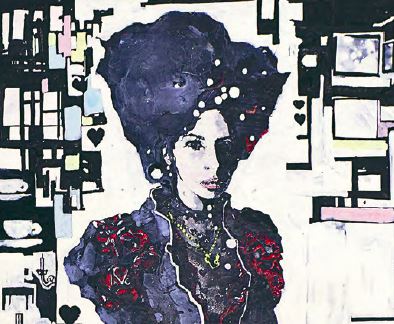 |
| the Blood Countess, Zak-style |
Lo and behold! One of the major NPCs is the Blood Countess herself. I won't add anything so as not to spoil the surprise for those who are going to play in A Red & Pleasant Land, but other tidbits similar to what has been appearing in my blog also appear in Zak's book, like her castle at Csachticz (spelled Cachtice in the book).
The art (obviously) is superb... More when I have time to read through the book.
Subscribe to:
Posts (Atom)