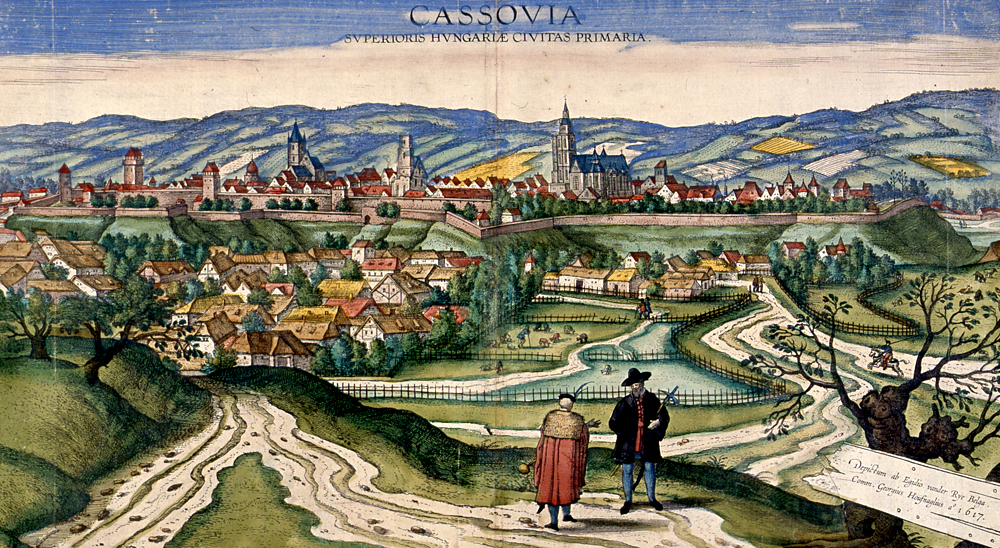
Kronstadt (sometimes also spelt Cronstadt) is a wealthy burg in the mountainous eastern half of the Fair Kingdom. Much like Clausenburg, it is firmly in the hands of the New Wayers.
A large part of the population consists of people descended from colonists from Teutonia who settled here between the 12th and the 14th century. The location of the city at the intersection of trade routes linking the Empire of the Crescent Moon and Western Europe has made it extremely rich. As a result, many guilds and traders houses of the eastern half of the Fair Kingdom are headquartered in Kronstadt.
Showing posts with label picture. Show all posts
Tuesday, 23 June 2015
Castles of the Fair Kingdom
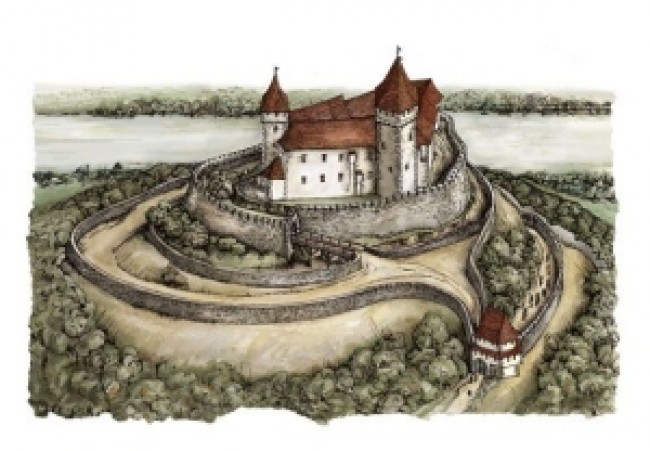
If you navigate to this web-site and click on the word ‘részletek’ next to the name of each single castle, you will see a drawing of said castle. Here are some of my favourite ones:
![]() |
| Castle Boldogkő |
![]() |
| Castle Zeßnegg |
![]() |
| Castle Großwaschon |
![]() |
| Castle Inselsburg |
Labels:
background,
inspirational,
picture
Thursday, 12 February 2015
Csachticz Weapons
A few commonly used weapons and protections at the time of the Blood Countess:
Despite the increased use of firearms, plate armour reaches its peak at the time of the Blood Countess, and the full suit of armour, commonly perceived as “mediaeval”, is actually only a feature of this period.
![]() |
| crossbow |
![]() |
| maces |
![]() |
| sword |
![]() |
| glaives |
![]() |
| partisan |
![]() |
| great-axe |
![]() |
| cannon |
![]() |
| musket |
Despite the increased use of firearms, plate armour reaches its peak at the time of the Blood Countess, and the full suit of armour, commonly perceived as “mediaeval”, is actually only a feature of this period.
![]() |
| plate armour |
![]() |
| shield |
Labels:
background,
picture,
weapon
Tuesday, 19 August 2014
The Blood Countess Died Exactly 400 Years Ago
Erzsébet Báthory, nicknamed the Blood Countess, died 400 years ago, on 21 August 1614.
(I would've posted this on 21 August, but I'll probably be without an internet connection on Thursday!)
She is probably the most (in)famous Hungarian noblewoman in history, as the No.1 female serial killer not only in Europe but in the whole world. She allegedly tortured and killed hundreds of girls between 1585 and 1610. After her trial in 1610, she was imprisoned in a walled area of her castle in December 1610, where she died slightly less than four years later. By the way, the 21st of August is the day she was found dead lying on the floor; she may have died earlier.
The most famous tale about the Blood Countess is that she had the girls bled to death so that she could bathe in their blood and retain her beauty. According to the Wikipedia, this is a later addition to her legend, a detail not mentioned at the time of her trial. Still according to the Wikipedia, György Thurzó noted the presence of horribly mutilated dead, dying, and imprisoned girls at the time of her arrest. György Thurzó was the man whom Emperor Matthias had asked to investigate the horrible rumours about the Blood Countess.
However, Emperor Matthias was heavily indebted to the incredibly rich countess, and, for political and religious reasons, he was also opposed to the Báthorys, who ruled large autonomous or semi-independent estates all over Central Europe. Some scholars argue that the whole rumourmongering and trial were the results of a vast conspiracy against the rich and independent-minded countess.
György Thurzó, the man who conducted the investigations and assembled the evidence was Archduke Matthias' right hand man before the latter became emperor. One of the consequences of the trial was that the Emperor never had to repay his debt to her.
Whatever the historical truth, you may use the Blood Countess in two ways in your campaign: as a horrible villain, or even as a vampire-like 'big boss' figure, or as innocent and fiercely independent woman. In this latter case, she could be the patron of the player characters, whose aim would be to thwart Thurzó's schemes in a politically-oriented campaign.
(I would've posted this on 21 August, but I'll probably be without an internet connection on Thursday!)
She is probably the most (in)famous Hungarian noblewoman in history, as the No.1 female serial killer not only in Europe but in the whole world. She allegedly tortured and killed hundreds of girls between 1585 and 1610. After her trial in 1610, she was imprisoned in a walled area of her castle in December 1610, where she died slightly less than four years later. By the way, the 21st of August is the day she was found dead lying on the floor; she may have died earlier.
The most famous tale about the Blood Countess is that she had the girls bled to death so that she could bathe in their blood and retain her beauty. According to the Wikipedia, this is a later addition to her legend, a detail not mentioned at the time of her trial. Still according to the Wikipedia, György Thurzó noted the presence of horribly mutilated dead, dying, and imprisoned girls at the time of her arrest. György Thurzó was the man whom Emperor Matthias had asked to investigate the horrible rumours about the Blood Countess.
However, Emperor Matthias was heavily indebted to the incredibly rich countess, and, for political and religious reasons, he was also opposed to the Báthorys, who ruled large autonomous or semi-independent estates all over Central Europe. Some scholars argue that the whole rumourmongering and trial were the results of a vast conspiracy against the rich and independent-minded countess.
György Thurzó, the man who conducted the investigations and assembled the evidence was Archduke Matthias' right hand man before the latter became emperor. One of the consequences of the trial was that the Emperor never had to repay his debt to her.
Whatever the historical truth, you may use the Blood Countess in two ways in your campaign: as a horrible villain, or even as a vampire-like 'big boss' figure, or as innocent and fiercely independent woman. In this latter case, she could be the patron of the player characters, whose aim would be to thwart Thurzó's schemes in a politically-oriented campaign.
Labels:
background,
inspirational,
picture
Thursday, 28 March 2013
Sunday, 3 March 2013
A Witch
| click to enlarge |
Edit 16/10/2014− I am adding a link to a fan-made 13th Age character class called... THE WITCH!
While wizards use carefully studied symbology and an occult grammatical system to work magic, and sorcerers draw intuitively upon the icons' power and the magic hidden within their own blood, witches tread a different, less direct path to arcane mastery. True, they often study occult lore, and some even manage to learn a few wizard spells. True, it is not uncommon for a witch to have a magical birthright that sets her forth on her journey or an unexpected link to one or more of the icons. But the witch sees each of these systems and links as a mere tool — one in a much larger toolbox that is well worth exploring. Beyond these basic starting points, the witch looks for the magical connections that these methods share and that bind all things, and she calls upon those beings that understand such phenomena better than she does. She does not limit herself to one narrow system, but pragmatically accepts each gift of arcane learning that Fate and the other occult powers send her way.
In time, the witch learns many useful tricks — spells, of course, but also hexes. The latter can be used with greater frequency, by deferring the arcane cost to another time — or another being. Most critically, by sensing the strands of Fate, she tries to work with them, instead of against them, taking the subtle path of least resistance to achieve her goals. Sadly, this may bring her to the attention of other beings that take an interest in Fate, as well as those exotic powers that she calls upon, from time to time, in pursuit of lore. For the witch, this is a small price to pay, to gain a deeper understanding of the most hidden workings of the universe.
Friday, 8 June 2012
A Fortress Within
A large swath of the Fair Kingdom is either occupied by the Empire of the Crescent Moon, or under the suzerainty of native nobles sympathetic to the Empire of the Crescent Moon— which can be quite generous in terms of the autonomy it leaves to the local aristocrats as long as they support the Empire.
As a result, those nobles who are either sympathetic to the Empire of the One Faith or try to stay neutral between the two opposing and powerful empires have to strengthen the borders of their holdings and demesnes lest the Crescent Moon takes advantage of their weakness. As a result, a whole chain of small border fortresses has sprung up within the Fair Kingdom rather than at its borders as used to be the case in the past.
| A typical fortress within the kingdom |
Labels:
background,
picture,
setting
Schemnitz
Schemnitz is an industrious mountain city in the north of the Fair Kingdom. It is situated in the middle of an immense caldera created by the collapse of an ancient volcano.
Who knows what lies in the depths of the caldera, below the tranquil city of Schemnitz...
Labels:
background,
geography,
picture
Wednesday, 6 June 2012
Kaschau
Kaschau, in the north east of the Fair Kingdom, is the ever rival city to its southern neighbour Clausenburg. Kaschau is just as busy and independently-minded as Clausenburg, and its burghers spend huge sums of money to build more beautiful and larger buildings than those of Clausenburg. The cathedral of Kaschau is the largest church in the Fair Kingdom.
One big difference, however, between the two rival cities is that the population of Kaschau is almost evenly split between Old Wayers and New Wayers. As a result, sectarian violence is a big problem in Kaschau and constantly hinders its catching up with arch-rival Clausenburg.
Labels:
background,
geography,
picture
Clausenburg
Clausenburg is the largest city in the mountainous eastern half of the Fair Kingdom. It is a hotbed of the New Way, and a busy trading city known for the entrepreneurial spirit of its burghers.
The Clausenburg nobles are known for being independently-minded, and for supporting neither of the two competing empires.
![]() |
| Clausenburg |
The Clausenburg nobles are known for being independently-minded, and for supporting neither of the two competing empires.
Labels:
background,
geography,
picture
Gran
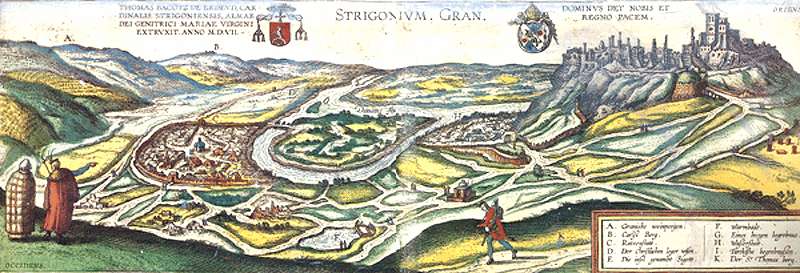
| View of Gran |
Gran is a large city in the north of the Fair Kingdom, situated between Pressburg, the current capital city, and Plintenburg, the residence of the Palatine. It is the seat of the Primate of the Church of True Faith in the Fair Kingdom, and is hence dubbed 'the capital city of the Old Wayers'.
The diocese of Gran is the largest and richest in the whole kingdom. Paradoxically enough, Gran marks the unofficial limit between the Old Way and the New Way of True Faith within the kingdom: to the west of Gran, most people follow the Old Way; to the east, the New Way.
Gran has been unsuccessfully besieged by the Empire of the Crescent Moon.
| Siege of Gran |
Labels:
background,
geography,
picture
Saturday, 2 June 2012
Temeschwar
This is a typical big city of the lowlands. "A" is the original fortified urban centre, "E" the suburbs of the city.
Temeschwar is currently occupied by the Empire of the Crescent Moon.
Labels:
background,
geography,
picture
Munkatz
This is a typical frontier fortress of the Mountains People.
The fortress has been cut in the rock itself. The area marked "9" around the fortress is the royal free city of Munkatz, mostly inhabited by the free Mountains People.
Labels:
background,
geography,
picture
Plintenburg
The fortified castle of the Palatine.
Actually not everybody considers him as the 'true' Palatine since he's only been elected by those nobles sympathetic to the Empire of the One Faith. Neutral nobles, and those leaning towards the Empire of the Crescent Moon, did not take part in the election.
Labels:
background,
geography,
picture
Ofen
This is Ofen, the former capital city of the Fair Kingdom. It is currently under occupation by the Empire of the Crescent Moon.
As a result, the capital city has been moved to Pressburg. However, the Palatine (regent) of the Fair Kingdom spends most of his time in his fortress at Plintenburg.
Labels:
background,
geography,
picture
Wednesday, 23 May 2012
The Black Death
Scenario seed: The player characters are in a walled city when there is an outbreak of bubonic plague in the surrounding area. The lord (or the council) of the city decrees that no one is allowed outside of or into the city, under pain of death, as a means to keep it safe from the Black Death. However, the PCs have some mission or quest underway and must try and illegally leave the city.
A harsher scenario seed: Now the PCs are trapped within a city where there's an outbreak of bubonic plague. However, no-one is allowed to leave the city out of fear that the epidemics is carried out to the rest of the country. The PCs must either try and illegally flee the city (as in the previous scenario seed), OR try and find a cure if they are somehow linked to the government of the city...
Wednesday, 16 May 2012
Subscribe to:
Posts (Atom)