Friday, 10 October 2014

The Pool of the Dejected Rusalki

The Hill Cantons blog has organised a small 'competition'. Each contestant had to write a short Eastern European-flavoured encounter. The winning entries would be included in Hill Cantons' upcoming sandbox supplement.

Well, apparently many contestants beat me, so I am publishing my entry on my blog.


John William Waterhouse - Hylas and the Nymphs

The Pool of the Dejected Rusalki

A dense wood of birch trees conceals this shallow pool. The pool itself is surrounded by immense weeping willows, which look like brooding green giants or trolls from a distance. The water is very still and greenish. All berry bushes in the area grow incredibly bountiful.

A long time ago, a wandering knyaz (knight) stopped here on one of his errands. The knight was insanely handsome, but somewhat of a womaniser, so he made up a tale of him knowing some magician who could transform the rusalki into normal women to take advantage of them and bed the rusalki — yes, all 12 of them. The pool is currently inhabited by the offspring of the knight and the original rusalki, who are much more humanlike than your average rusalka (-2 to any spell that detects or affects glamorous/fey creatures, etc.)
The rusalki are still waiting for their father to return, break their bond to the pool, and transform them into human females.

If a party approaches the pool, 2D4 rusalki will exit the water and start walking, all beguiling smiles, towards the most 'knightly'-looking character, e.g., one wearing full plate armour or, if no PCs wear plate armour, one who looks or acts aristocratic.

Now two things may happen:

(1)- The party doesn't take any offensive action.
The rusalki will ask the "knight" to enter the pool with them. If he resists, they will try and drag him into the pool. If the party becomes aggressive see (2) below; if not, the "knight" is carried into the pool where the remaining rusalki assemble and ask him to vow to return with the magician. If the "knight" agrees, the party will be left alone, and even provided food, water, and more. If the "knight" refuses, the rusalki disappear under water never to be seen again. In the following 1D6 days, any woodland creature encountered by the party will be extremely aggressive towards them. Double the occurrence of any woodland wandering monster roll.

(2)- The party becomes offensive.
Whilst the initial rusalki surround the "knight", 3D4 more rusalki appear from the pool (just their head and shoulders) and start gazing at the other characters. A PC must successfully save vs magic or under his wisdom [depending on your favourite rules] or become entranced by the sight of the fabulously beautiful rusalki. An entranced PC will just stand idly and do nothing.
The rusalki around the "knight" will try and grab him to bring him into the pool.
(2a)- If the "knight" resists or tries to harm them, the rusalki will animate the branches of the weeping willows. Each rusalka may animate 2 branches. The two branches attack in co-operation: whenever one of the branches has successfully hit (it attacks as a 4 HD monster), it entangles its victim, which cannot move or fight any longer. The other branch then tries to strangle the immobile victim (it needs a hit); from the next round on, it will start suffocating it (1D6 automatic dmg per round).
(2b)- If the "knight" does not resist, he will be carried into the pool where the remaining rusalki assemble and ask him to vow to return with the magician. If the "knight" agrees, the party will be left alone, and even provided food, water, and more. If the "knight" refuses, the rusalki disappear under water never to be seen again. In the following 1D6 days, any woodland creature encountered by the party will be extremely aggressive towards them. Double the occurrence of any woodland wandering monster roll.

The encounter does not end here, though. If the "knight" has vowed to return with the magician, he has put himself under a strong geas, per the classic fantasy 'geas' spell, to find a magician who can transform the dejected rusalki into human females.

Friday, 3 October 2014

The Rusalka

Rusalka, by I. Bilibin
Even though the tentative weird fantasy setting described within this blog is supposedly "Central European"-flavoured, I will sometimes touch upon more Balkanic or Eastern European subjects. I particularly like Eastern European folklore; it is similar enough to the more familiar Western European folklore, yet it does retain some exotic aspects. I particularly like the Eastern European depiction of the fey people: the various rusalki, domovyie, vodyanyie, etc.

So let's enquire into the rusalka (plural: rusalki) today. The Wikipedia describes her as “a water nymph, a female spirit in Slavic mythology. She is the equivalent of a mermaid: a legendary aquatic creature with the upper body of a female human and the tail of a fish. According to most traditions, rusalki were fish-women, who lived at the bottom of rivers. In the middle of the night, they would walk out to the bank and dance in meadows. If they saw handsome men, they would fascinate them with songs and dancing, mesmerise them, then lead them away to the river floor to their death”.

Also: “Rusalki were linked with fertility and weren't considered evil before the nineteenth century. They came out of the water in the spring to transfer life-giving moisture to the fields”.

Well, causing young men to drown isn't particularly 'good' behaviour, but one may think that this was unintentional on the rusalki's side, and that they were overall 'neutral', much like druids are, because they are linked to Nature. Also, as life-giving fertility nymphs, rusalki are definitely the clear opposite of undead. So how come they are listed amongst the undead in many frp games?

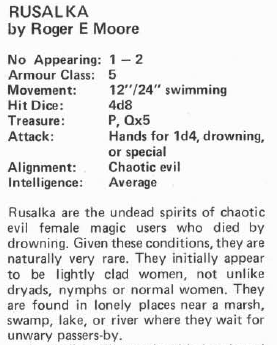
I suspect the fault lies with the very first description of the rusalka as a D&D monster by Roger E Moore in issue No.34 of White Dwarf:


"Undead spirits"... OK, the Wikipedia states that “in nineteenth century versions, the rusalka is an unquiet being who is no longer alive, associated with the unclean spirit and dangerous”.

"Chaotic evil", OK, we've already seen that drowning people is evil... but why "female magic-users"??

"Who died by drowning"– now this is a complete permutation of the original creature: rusalki were supposed to drown people, not the other way round!

I may be mistaken but apparently there were no other rusalki in early *D&D products, except in issue No.290 of Dragon Magazine, which was a 'Slavic'-themed special issue. The rusalka was amongst the new monsters in that issue:
“Rusalkas [sic] are female spirits who dwell in the lakes, rivers, and streams of Russia. Their beguiling song is known to lure men to their watery graves”
“The rusalkas are believed to be the restless spirits of drowned maidens, tied to the place of their deaths”

They appear in Pathfinder as “cruel and bitter fey”, who “are not undead”, which is quite close to their true Slavic folklore origin.

The various retro-clones seem to have ignored the rusalka, except for Swords & Wizardry, which has the following:
“Rusalka are undead maiden-witches that haunt the cold rivers and lakes in which they drowned. In appearance, rusalka first appear to be comely maidens, clad only in fog. Upon close inspection, however, they are cadaverous with dishevelled hair and eyes that shine with evil green fire.”

Thursday, 25 September 2014

Monsters & Magic RPG is in the Latest Bundle of Holding RPG Pack

If you are True Role-Players I gather you already know about the Bundle of Holding web-site: it is an easy way to acquire a bundle of PDF files of role-playing games and/or supplements at a significantly lower price than the addition of buying each of them separately.

The other cool thing about the "Bundle of Holding" special offers is that ten percent of your payment goes to two charities, viz.
 - Amnesty International
 - Doctors Without Borders

Note that you get to set your payment yourself, but you have to beat a minimum amount to get hold of the "bundle". Also, there are usually two steps, one basic bundle, and one with more nifty stuff in it. However, there is no upper limit. This is a nice way to encourage giving to the charities.

But the bundles are short-lived, and you must act quick to grab 'em!

Well, all this premise to tell you that the current Bundle of Holding is  a treasure trove of seven indie RPGs by women RPG writers. Amongst the games of the second tier, the fantastic Monsters & Magic role-playing game (by Sarah Newton), which is currently my game of choice for high fantasy.

Tuesday, 19 August 2014

The Blood Countess Died Exactly 400 Years Ago

Erzsébet Báthory, nicknamed the Blood Countess, died 400 years ago, on 21 August 1614.

(I would've posted this on 21 August, but I'll probably be without an internet connection on Thursday!)

She is probably the most (in)famous Hungarian noblewoman in history, as the No.1 female serial killer not only in Europe but in the whole world. She allegedly tortured and killed hundreds of girls between 1585 and 1610. After her trial in 1610, she was imprisoned in a walled area of her castle in December 1610, where she died slightly less than four years later. By the way, the 21st of August is the day she was found dead lying on the floor; she may have died earlier.

The most famous tale about the Blood Countess is that she had the girls bled to death so that she could bathe in their blood and retain her beauty. According to the Wikipedia, this is a later addition to her legend, a detail not mentioned at the time of her trial. Still according to the Wikipedia, György Thurzó noted the presence of horribly mutilated dead, dying, and imprisoned girls at the time of her arrest. György Thurzó was the man whom Emperor Matthias had asked to investigate the horrible rumours about the Blood Countess.

However, Emperor Matthias was heavily indebted to the incredibly rich countess, and, for political and religious reasons, he was also opposed to the Báthorys, who ruled large autonomous or semi-independent estates all over Central Europe. Some scholars argue that the whole rumourmongering and trial were the results of a vast conspiracy against the rich and independent-minded countess.

György Thurzó, the man who conducted the investigations and assembled the evidence was Archduke Matthias' right hand man before the latter became emperor. One of the consequences of the trial was that the Emperor never had to repay his debt to her.

Whatever the historical truth, you may use the Blood Countess in two ways in your campaign: as a horrible villain, or even as a vampire-like 'big boss' figure, or as innocent and fiercely independent woman. In this latter case, she could be the patron of the player characters, whose aim would be to thwart Thurzó's schemes in a politically-oriented campaign.

Aperita Arcana Nearing Completion

Aperita Arcana is a dual-system supplement for both the Monsters & Magic and the Fate game systems (to be honest, I want it because of what it brings to M&M).

It is being brought out by Ebon Gryphon Games, the very same good folk who are behind the fantastically useful Collectanea Creaturae supplement, also both for Monsters & Magic and Fate.

Aperita Arcana adds a lot of character classes to the basic ones in the M&M core book; the current roster is as follows:
 - Alchemist
 - Arbiter
 - Barbarian
 - Beastmaster
 - Blademage
 - Blood Mage
 - Bounty Hunter
 - Chosen
 - Cultist
 - Duelist
 - Elementalist
 - Enchanter
 - Gladiator
 - Inquisitor
 - Knight-errant
 - Martial Practitioner
 - Mercatant
 - Minstrel
 - Religious Scholar
 - Shaman
 - Summoner
 - Treasure Hunter
 - Vanguard
 - Wandering Sage
 - Witch Hunter

Some of these classes, e.g., the Alchemist, have already been posted on the Google+ M&M community. Check them out, they're really fantastic!

I used to hate new classes when I played AD&D, but for Monsters & Magic it is really different: since a class a mostly a collection of traits, they add wonderful role-playing potential in terms of what effect the player may try to attain.

The icing on the cake is that Aperita Arcana is going to be FREE for us backers of the Collectanea Creaturae kickstarter :-)

Friday, 25 April 2014

Collectanea Creaturae In Dead Tree

Collectanea Creaturae, the top-notch "monster manual" supplement for Monsters & Magic is now available in dead tree format from Amazon in the United States.

It should also be available soon from RPGnow and from the European Amazon web-sites.

Tuesday, 8 April 2014

Collectanea Creaturae Is Out!

I just love it when a Kickstarter project delivers on time. Collectanea Creaturae, the book of creatures (and more!) for the Monsters & Magic role-playing game has been funded in January 2014, and the availability date for my pledge level (PDF only) was shown as "Estimated delivery: May 2014". Well, I have just received from Ebon Gryphon Games the link to download my copy of the PDF, and it's only April :-)

The book is a whopping 170 pages long, with the following sections:

Introduction, 5 pages.
This is actually much more than a mere introduction. The 5 pages are chock full of great ideas about how to GM particular situations in Monsters & Magic. If you've ever tried GM'ing an old school module doing conversions on the fly, like I did, you'll find this part very useful.

A-Z List of Creatures, 130 pages
The creatures here are not mere stat blocks. Each of them is given motivations and effects, which are what makes Monsters & Magic really different from similar games. Some of the entries have so many ideas of cool effects and consequences that they provide all the necessary elements for an afternoon of gaming just by themselves!

Also, some groups of creatures are given their own stats, e.g., Bandit Gang has its own stats independently from Bandit. Wolfpack has its own stats independently from Wolf. Again, this is perfectly in line with M&M's elegant way of handling different "sizes" of encounters.

There are also many boxed texts interspersed through this section providing interesting facts about the various creatures such as etymology of the creature's name, differences with the classic fantasy version (if any, and why), possible variations (incl. powered up versions or "bosses"), constructs made or owned by the creature, suggestions to use some of the creatures as non-human races, etc.

Appendix 1: New PC Races, 7 pages
The races suggested as being available as PC races are: Centaur, Faun, Goblin, Lamia, Nymph, Orc, Tanuki.

Appendix 2: Familiars, Animal Companions, and You, 12 pages
The title says it all. Given the importance of companions, sidekicks, mounts, etc. in Monsters & Magic, this is again a very welcome chapter, chock full of interesting ideas.

I've only skimmed through Collectanea Creaturae, but I already know I won't be able to GM my M&M games without this book close by any longer!